ATLAS observes new Bc meson excited state
21 May 2026 | By
The ATLAS Collaboration reports the first observation of the Bc*+ meson – a new composite particle state containing a charm quark and a bottom antiquark.
Protons and neutrons – the building blocks of matter – belong to a huge class of particles called hadrons. Hadrons are composite particles made of quarks that are bound together by the strong force. They are classified into two groups: baryons, which consist of three quarks (like protons and neutrons), and mesons, which are formed by a quark–antiquark pair.

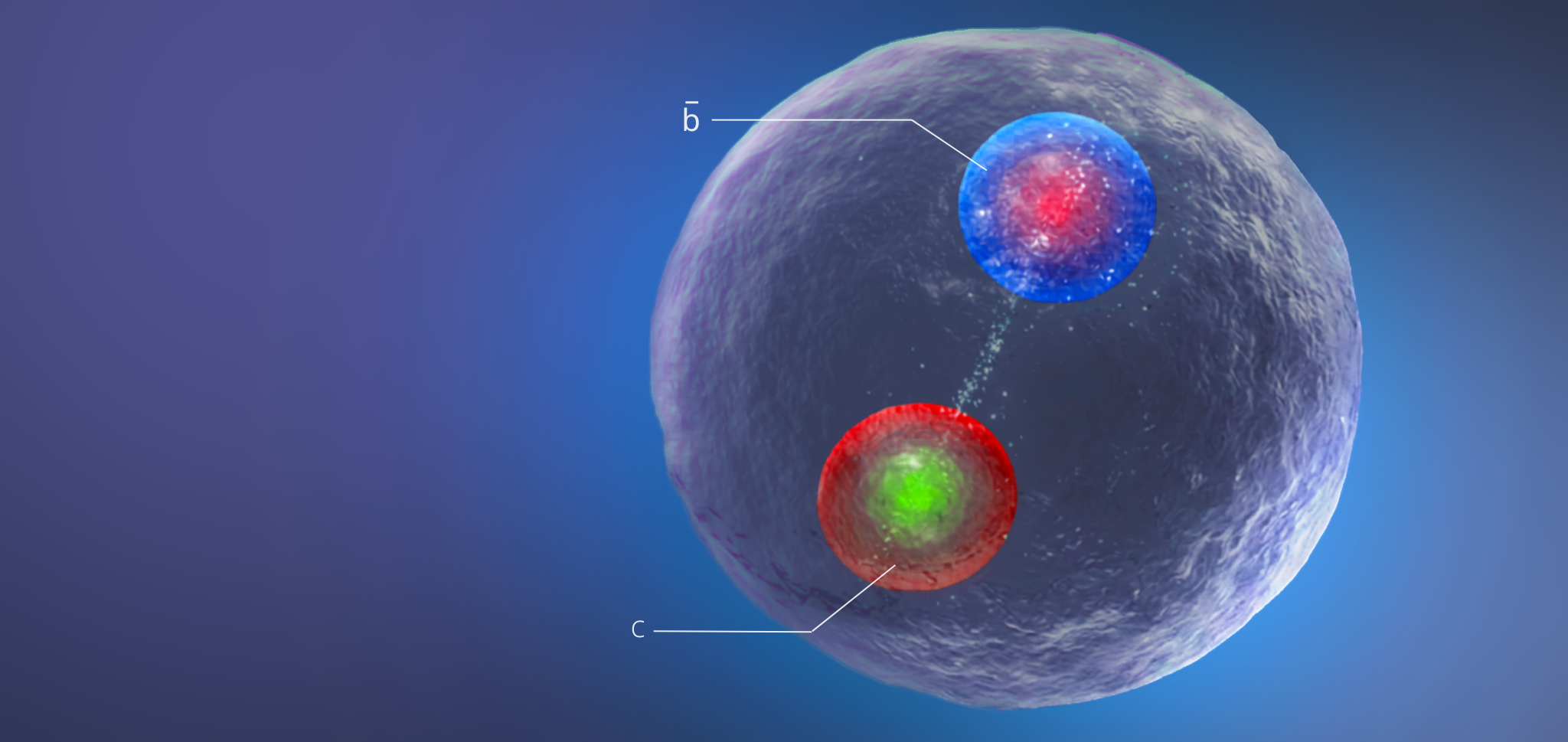
Despite decades of study, many aspects of the strong force remain poorly understood, particularly the way it binds quarks together inside hadrons. Mesons made of heavy quarks – such as charm or bottom quarks – can provide an important laboratory for testing theoretical descriptions of these effects. Of particular interest to physicists are Bc+ mesons, as they contain two types of heavy quarks: a charm quark and a bottom antiquark (b̅c).
In a new result presented at the Large Hadron Collider Physics 2026 conference, physicists from the ATLAS Collaboration report the first observation of a particle with properties consistent with the Bc*+ meson, the lowest excited Bc+ meson. Much like electrons shifting orbits inside an atom, quarks inside hadrons can exist in different energy states. Excited states are expected to be heavier than the corresponding ground state. In the Bc*+ meson, the charm quark and bottom antiquark should have spin orientations aligned in the same direction, whereas in the ground-state Bc+ meson their spins are oppositely oriented.
The new particle appears as a striking peak in the distribution, with a significance exceeding 8 standard deviations.
This new member of the meson family decays into a Bc+ meson and a photon (see Figure 1). One of the main challenges physicists faced when searching for the Bc*+ meson is that its mass is expected to exceed that of the Bc+ meson by only a few tens of MeV. As a result, the photon produced in the decay carries very little energy and is very difficult to measure in a detector like ATLAS.
For their search, researchers focused on Bc+ meson decays into three muons and an “invisible” neutrino. This decay mode is not typically studied in searches for new hadron states since neutrinos cannot be reconstructed. However, it occurs around twenty times more frequently than other fully-reconstructable decay modes – a gain that outweighs the complication of partial reconstruction.


Detecting the low-energy photons produced in Bc*+ decays posed an additional challenge. Instead of using standard photon-identification techniques, which would be completely insensitive to these photons, physicists looked at cases of “photon conversion”. This is where the photon produces an electron-positron pair within the ATLAS tracking detector, leaving behind closely-spaced charged-particle tracks originating from a common point. These tracks can have transverse momenta as low as 100 MeV – significantly lower than those typically studied in ATLAS analyses – requiring a dedicated track-reconstruction procedure.
The new particle appears as a striking peak, with a significance exceeding 8 standard deviations, in the distribution of the invariant mass difference between the combined muon-triplet-plus-photon system and the muon triplet alone (see Figure 2). The measured mass difference between the Bc*+ meson and the Bc+ meson is 64.5 ± 1.4 (stat.) +1.0−1.4 (syst.) MeV. This is within the range of the available theoretical expectations, though slightly deviating from the most recent, high-precision modern calculations. This result provides valuable new input for theoretical models describing the heavy-hadron mass spectra and will help to improve the understanding of the strong interaction.
Learn more
- Observation of a Bc*+ meson with the ATLAS detector (arXiv:2605.16228, see figures)
- LHCP 2026 presentation by Semen Turchikhin: Heavy flavor spectroscopy at ATLAS
- LHCP 2026 presentation by Anna Sfyrla: ATLAS Highlights
- ATLAS observes new composite particle, CERN News, 22 May 2026