Getting to the top of jet calibration
16 February 2026 | By
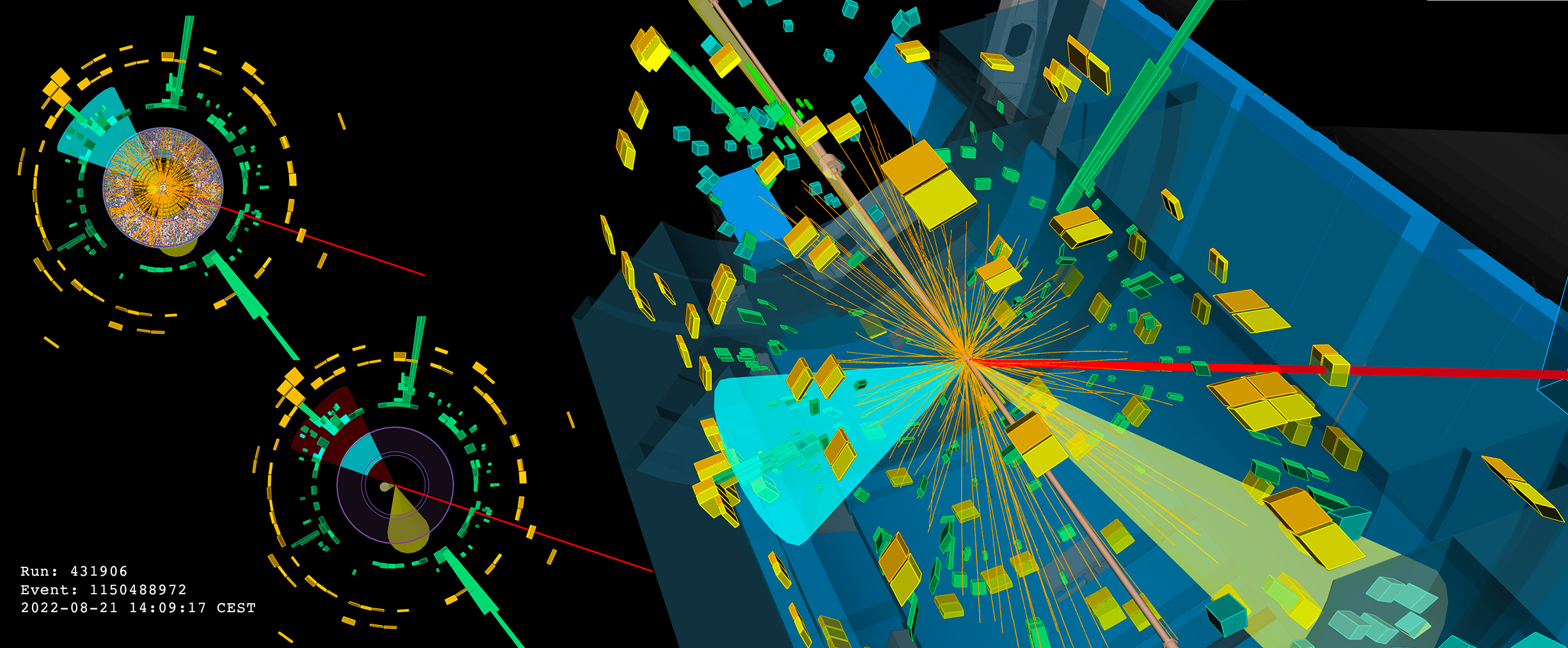
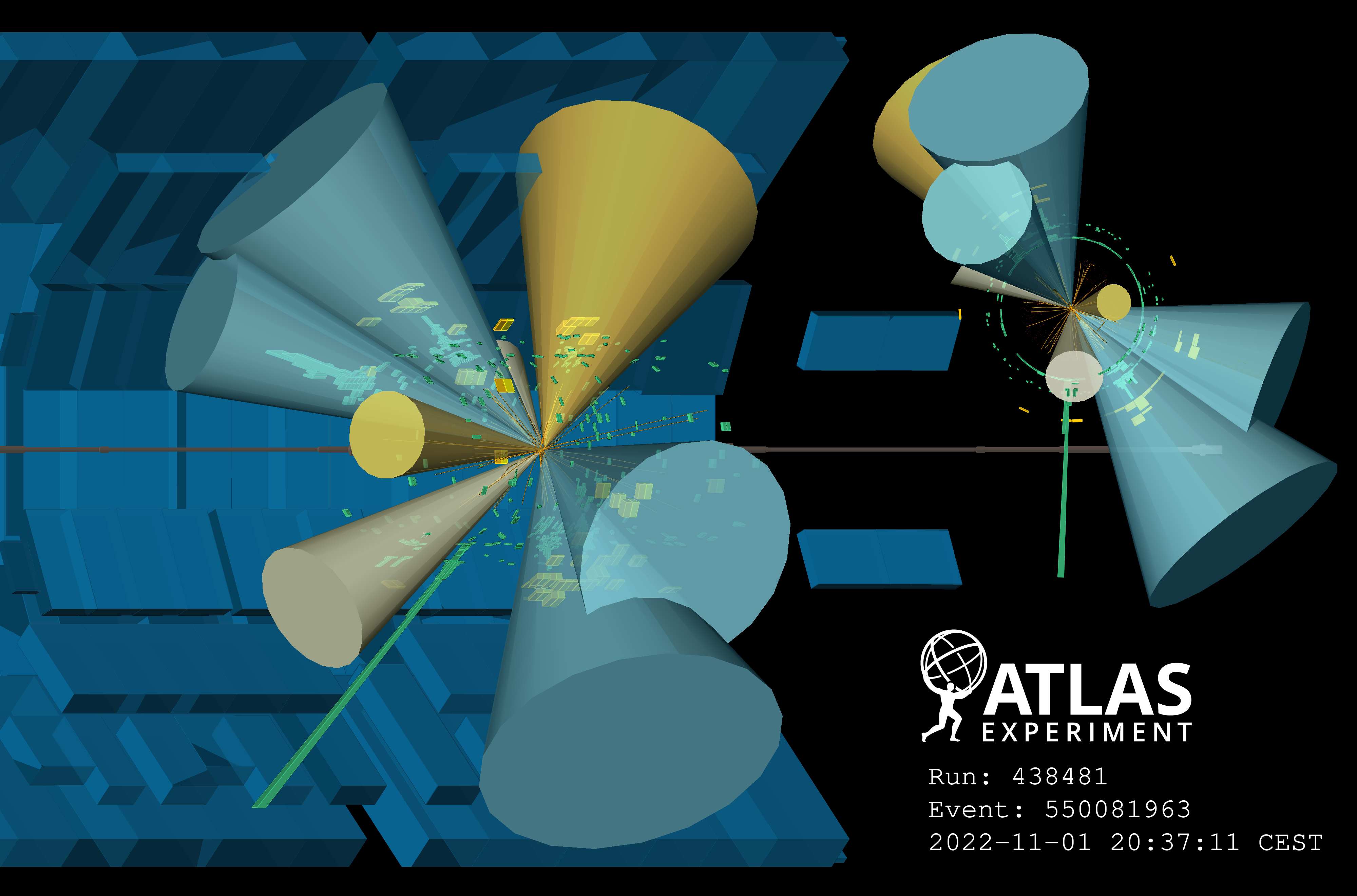
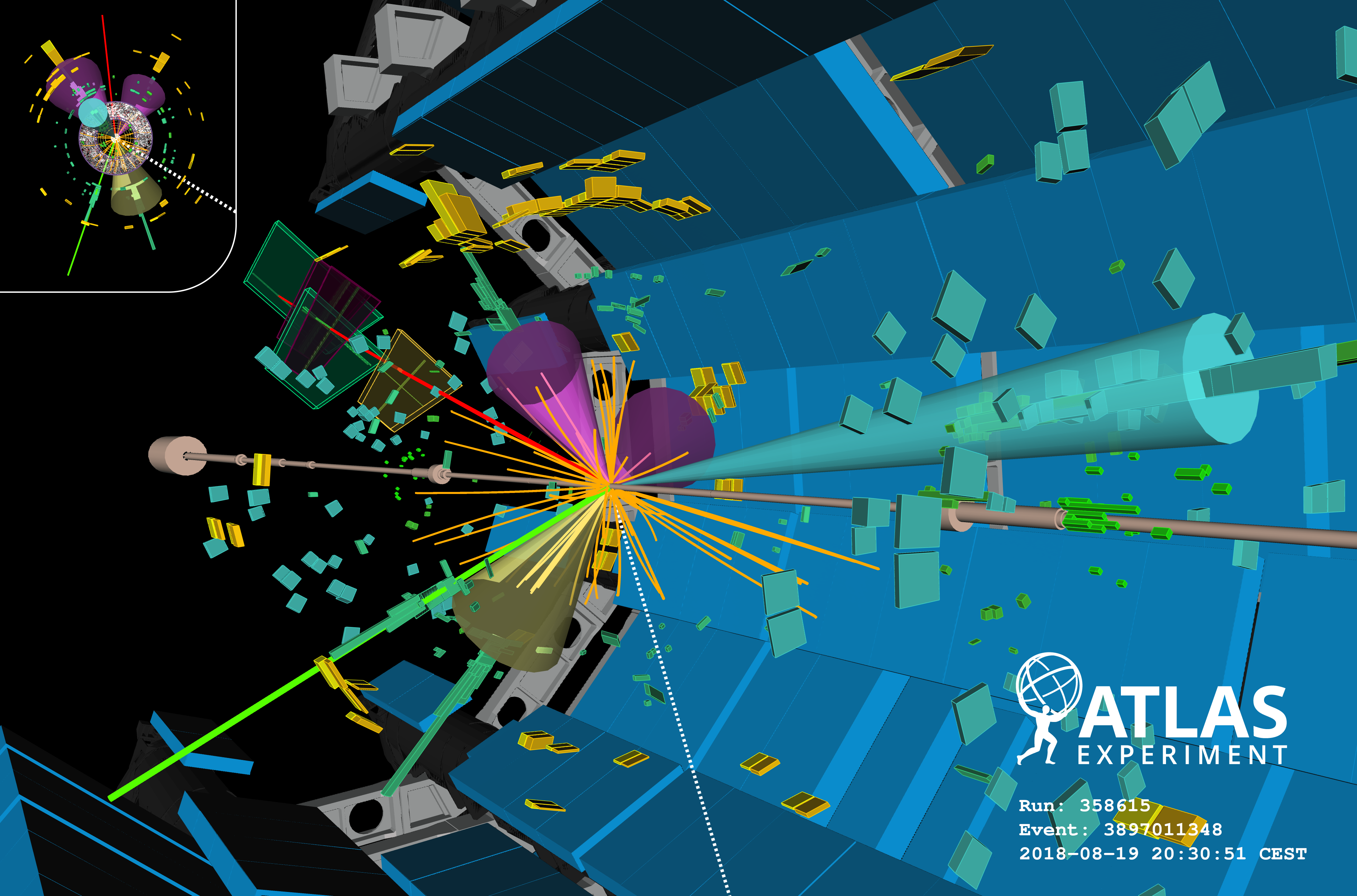
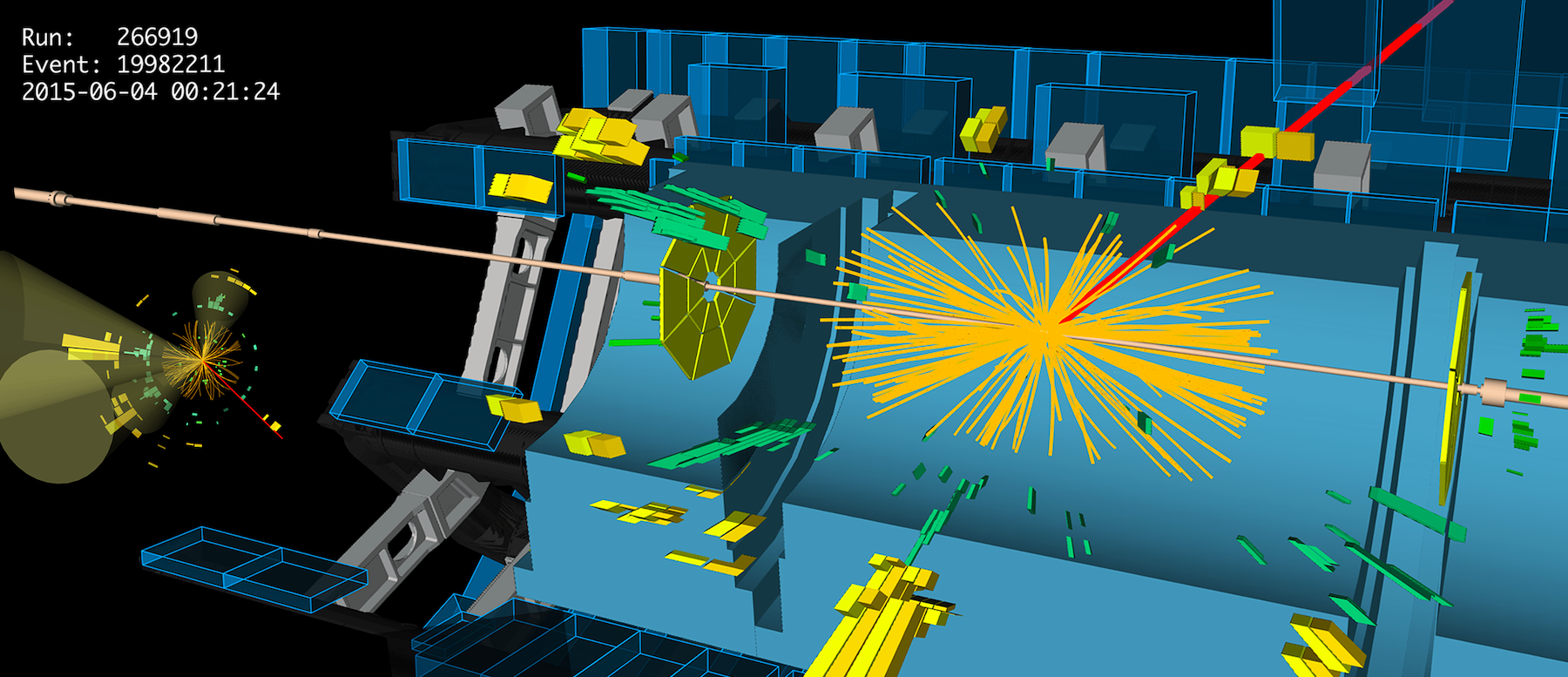
When particles burst from an LHC collision, they rarely leave a simple, single trail for physicists to follow. More often, they are high-energy quarks and gluons that erupt into jets, collimated sprays of particles that make up the most common "footprints" left in the ATLAS experiment. A precise determination of jet properties is vital for several Standard Model studies, such as top-quark mass measurements, as well as searches for new physics phenomena. However, accurate jet measurements can be notoriously challenging, and ATLAS physicists are continuously developing new techniques to improve their precision.
Key to this is calibration. Physicists consider two quantities: the jet energy scale (JES), which describes how accurately the average reconstructed jet momentum reflects the true momentum; and the jet energy resolution (JER), which characterises the repeatability of that measurement. JES and JER calibrations are obtained using both simulation and data-driven correction factors. Simulation-based corrections account for information that is not measured by the ATLAS experiment, while data-driven corrections address possible imprecise modeling of the detector material and particle interactions. Traditionally, physicists have relied on the principle of momentum conservation to guide data-driven corrections. By studying collision events in which a jet recoils against a well-measured reference object (i.e. a lepton or photon), they can precisely infer a jet’s momentum. While highly effective, this approach can face limitations in certain situations.
Physicists have pioneered a novel technique to calibrate jets – collimated sprays of particles that make up the most common "footprints" left in the ATLAS experiment.


In a new result released by the ATLAS Collaboration, researchers describe a new JES and JER calibration method using top quarks. Specifically, they considered top-quark decays to a W boson and a b-quark, where the W boson subsequently decays to two jets. As the W-boson mass has been precisely measured, it is the ideal reference for in-situ jet calibration. The ATLAS team created templates of the reconstructed W-boson mass distribution with different assumptions for the JES and JER (see Figure 1). They then fit the mean and width of these distributions to the data in order to extract the optimal corrections.

Researchers studied data collected during both LHC Run 2 (2015–2018) and the first years of Run 3 (2022–2023). Considering these periods separately was vital, as detector aging, changes in detector material and differences in LHC operating conditions could affect how jets are recorded. Additionally, significant improvements had been made to Run-3 simulations, informed by Run 2 experience and enhanced physics modeling. Because a detector's response depends on a particle's momentum, the team extracted separate corrections for the JES and JER calibrations across different jet momentum intervals. Figure 2 shows the W-mass distribution before and after applying corrections fitted from data, clearly demonstrating the impact of accurate calibration.
The new ATLAS method was found to be competitive with established techniques for jets with momenta between 35 and 200 GeV, achieving uncertainties of about 1% for JES and about 15 to 20% for JER. When combined with standard ATLAS techniques, it will allow researchers to reach new precision in jet measurements.
While a similar approach was successfully used in top-quark-mass measurements, this is the first application of the technique on jet calibration in ATLAS. As the precision of top-quark measurements improves, this new method has the potential to become one of the most powerful approaches to calibrate jets.
Learn more
- Calibration of the jet energy scale and resolution of small-radius jets using semileptonic tt¯ events with the ATLAS detector (arXiv:2512.17482, see figures)
- Boosting precision of top-quark mass measurement with ATLAS, Physics Briefing, March 2025