When scattered vector bosons shine
25 September 2026 | By
The ATLAS Collaboration has observed, for the first time, two photons produced through the scattering of W bosons. This rare process provides a new and powerful test of the electroweak sector of the Standard Model of particle physics.
Two of the four fundamental forces of nature – the electromagnetic and the weak forces – are described within the Standard Model of particle physics by a unified framework known as electroweak theory. The particles that carry these forces are well established: W and Z bosons mediate the weak force, while photons mediate the electromagnetic force.
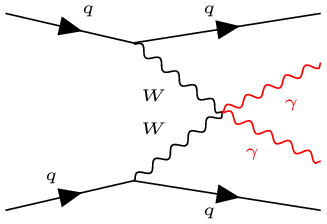
But these particles do not simply carry forces between matter particles; they can also interact with one another. Such interactions provide a powerful way to test the Standard Model, particularly through processes known as vector-boson scattering (VBS), in which two force-carrying particles scatter and produce two more.
The ATLAS Collaboration has studied a range of VBS processes. Their latest result provides the first observation of W-boson scattering producing two photons. With this result in hand, the Collaboration completes the full set of observations of VBS processes predicted by electroweak theory, where massive vector bosons (W and Z) scatter into combinations of W bosons, Z bosons and photons.
Put your sunglasses on
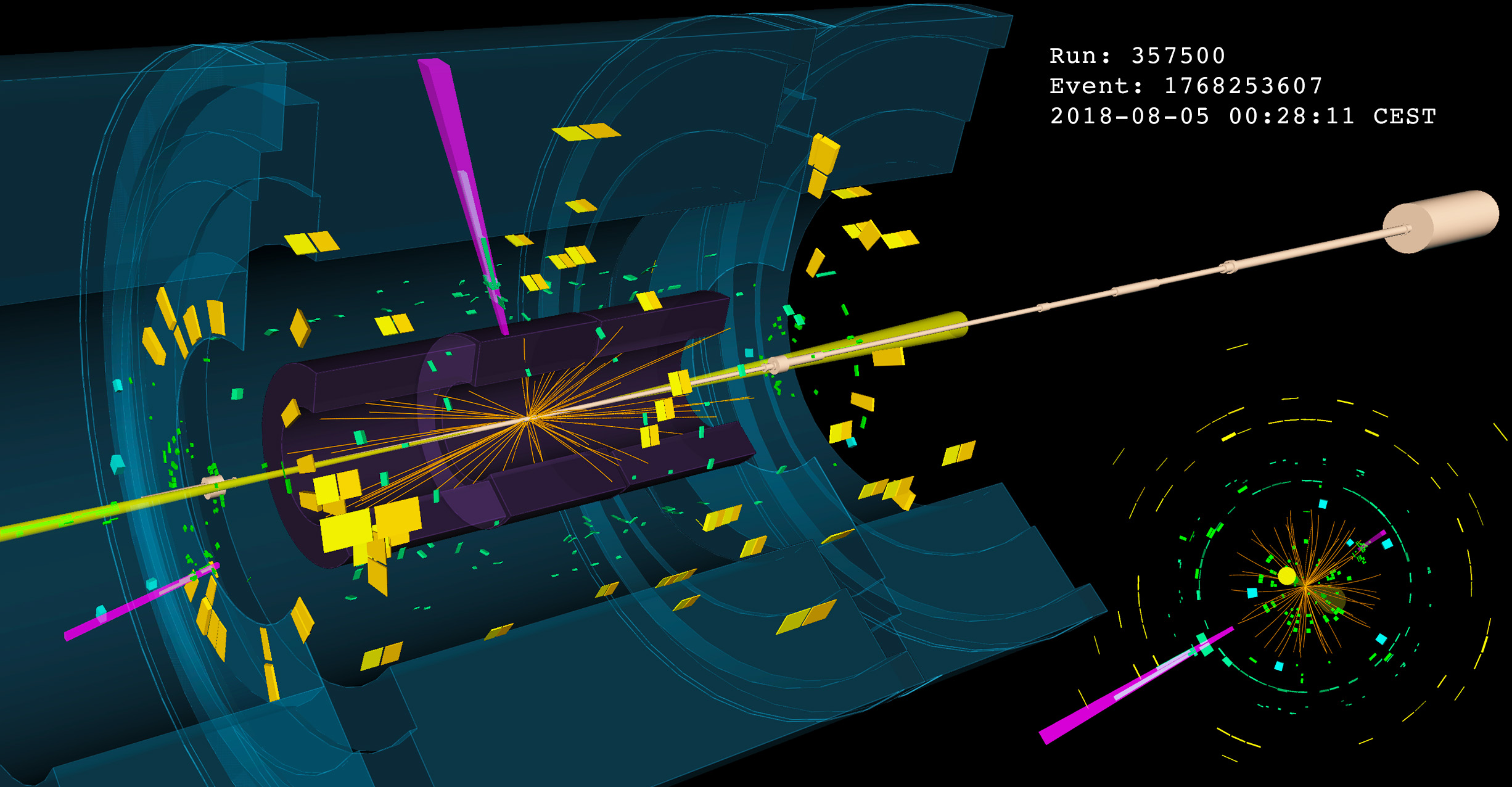
In proton–proton collisions at the Large Hadron Collider (LHC), two quarks can each radiate a W boson. These W bosons then scatter and produce two photons, while the quarks emerge as sprays of particles known as jets (EW-γγjj, see Figure 1). The photons created in these collisions are physically the same as sun-rays, but have much higher energy. Spotting them requires rather more than good sunglasses; the ATLAS experiment uses half a metre of lead and liquid argon calorimeters to detect them and precisely measure their energy.
The EW-γγjj process leaves a distinctive experimental signature in ATLAS: two high-energy jets that are widely separated from one another and consequently have a large invariant mass. This proved crucial in the major challenge of separating the extremely rare signal from much more abundant background processes. The dominant background – which is around 1000 times more likely – also produces two photons and two or more jets, but through the strong interaction (QCD-γγjj). By focusing on events with the characteristic signature, ATLAS physicists were able to cut this number down such that approximately one in 6 selected events were expected to come from the signal process.
Figure 2 compares the EW-γγjj signal process to the QCD-γγjj background process as a function of the mass of the two jets. The rarity of the EW-γγjj signal meant that physicists needed to understand the background to a precision of about 7%. This was achieved through detailed studies comparing simulated events with data in extreme regions of phase space that are incredibly hard to compute theoretically and are therefore associated with large uncertainties.
While observing this rare phenomenon is in itself a powerful confirmation of the electroweak theory, it also provides an opportunity to search for subtle signs of new physics.
First observation
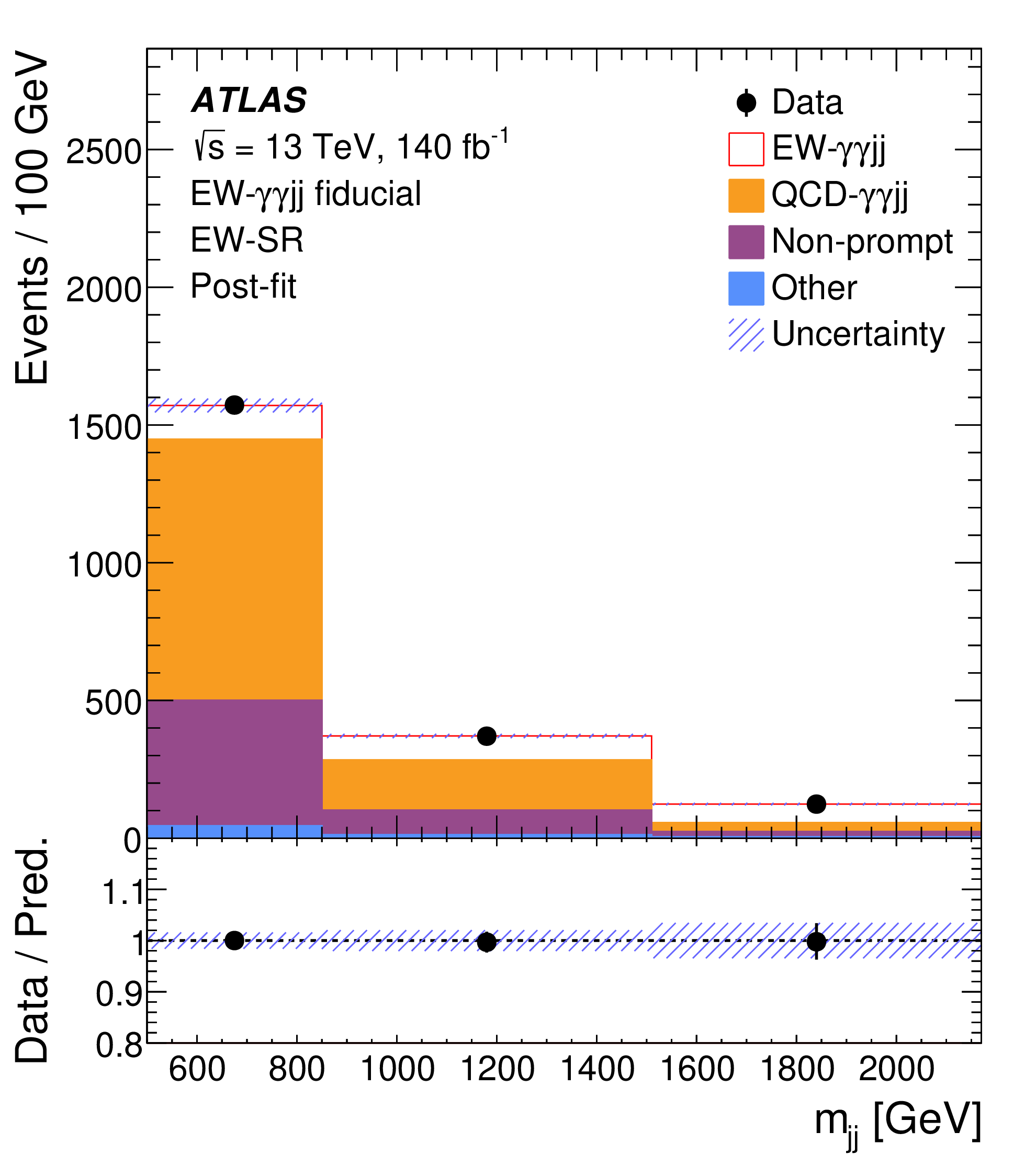
Using the full LHC Run-2 dataset (collected 2015–2018), the ATLAS Collaboration observed two-photon production through vector-boson scattering with a statistical significance of 6.2 standard deviations. The measured production rate is 13.8 ± 3.0 fb, consistent with the Standard Model prediction of 17.1 ± 2.4 fb, and the team also studied how this rate varies across different kinematic variables. These results provide a detailed picture of the process, and will be valuable for future measurements and theoretical computations.
While observing this rare phenomenon is in itself a powerful confirmation of the electroweak theory, it also provides an opportunity to search for subtle signs of new physics. Physicists performed a model-independent interpretation of the measurement where additional interactions of four W or Z bosons and photons introduce subtle deviations from the electroweak theory. They found no hints for such deviations and provided leading constraints on certain classes of interactions. For now, all is well with the electroweak theory.
This result concludes a years-long programme in which the ATLAS Collaboration has observed all VBS processes predicted by electroweak theory in which massive vector bosons scatter into combinations of photons, W bosons and Z bosons. Together, these measurements provide a comprehensive understanding of the electroweak sector of the Standard Model. The expanded datasets collected during Run 3 and expected from the forthcoming High-Luminosity LHC will enable physicists to study these rare interactions with enhanced precision – providing more stringent tests of the Standard Model and new opportunities to search for physics beyond it.
Learn more
- Observation of the electroweak production of the electroweak production of yyjj at 13 TeV in 140 fb–1 of proton–proton collision data with the ATLAS detector (arXiv:2607.25869, see figures)
- ICHEP 2026 presentation by Muhammad Alhroob: Measurement of rare electroweak processes in ATLAS
- ATLAS maps the rare four-way intersections of the weak force, Physics Briefing, April 2026
- ATLAS observes W-boson pair production from light colliding with light, Physics Briefing, August 2020
- Quarks observed to interact via minuscule “weak lightsabers”, Physics Briefing, July 2018
- All ATLAS Physics Briefings on Vector Boson Scattering results