ATLAS 2025 Thesis Awards spotlight the “soul” of the Collaboration
26 February 2026 | By

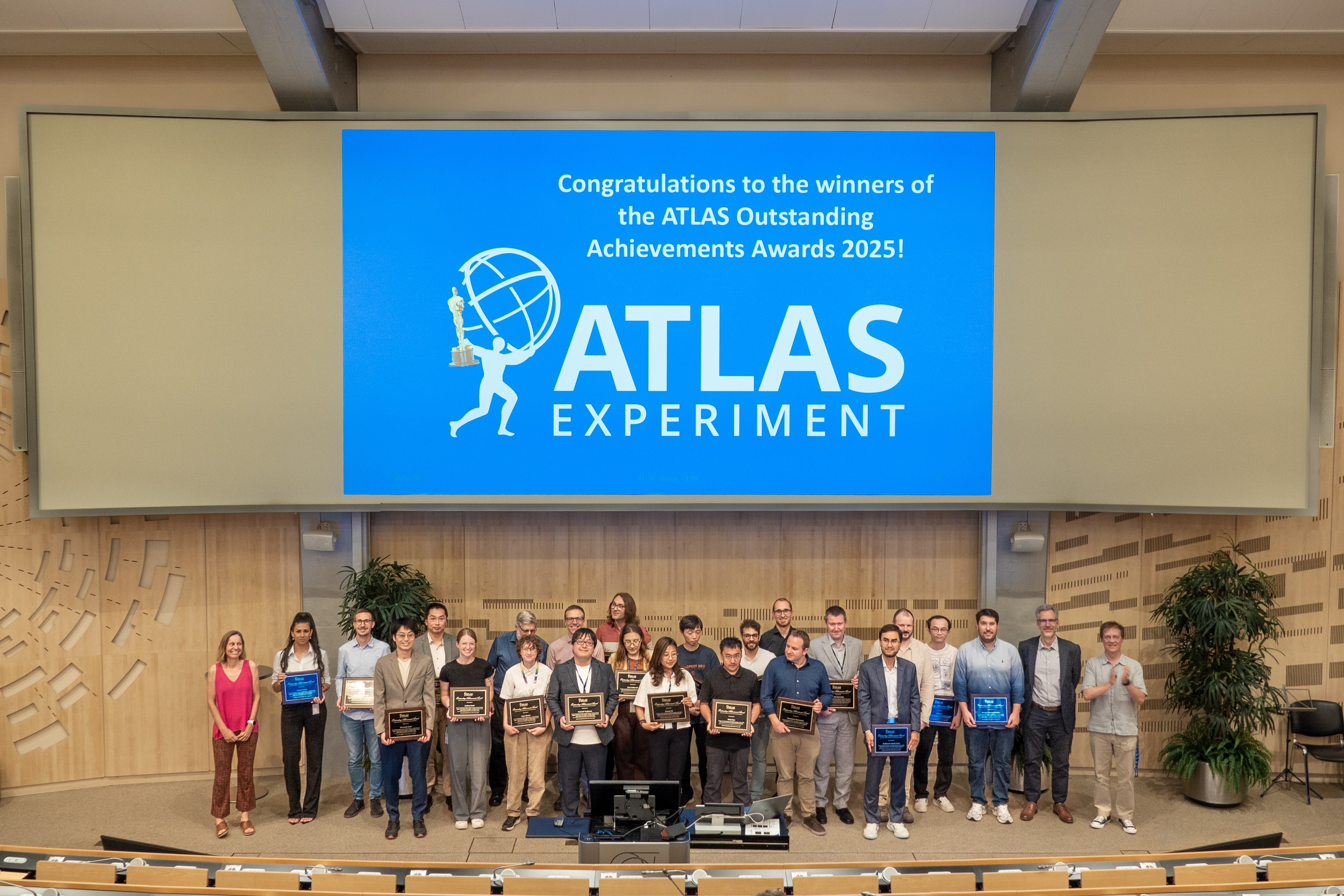
On 19 February 2026, the ATLAS Collaboration gathered in CERN’s Main Auditorium for the 2025 Thesis Awards – an annual celebration of the vital role of PhD students within the experiment.
From physics analysis and detector operations to software development and upgrade work, ATLAS PhD students make critical contributions to the Collaboration’s scientific mission while completing their degrees. This year’s ATLAS Thesis Awards drew from more than 200 eligible theses, reflecting both the scale of the collaboration and the breadth of student research. From this pool, the committee reviewed 36 formal applications before selecting eight winners.
This year’s recipients are: Takumi Aoki from the University of Tokyo (Japan), Kartik Deepak Bhide from Albert-Ludwigs-Universität Freiburg (Germany), Antonio Jesús Gómez Delegido from Universitat de València (Spain), Simon Florian Koch from the University of Oxford (UK), Elena Mazzeo from Università degli studi di Milano (Italy), Ryan Roberts from the University of California, Berkeley and Lawrence Berkeley National Laboratory (USA), Stephen Nicholas Swatman from the University of Amsterdam (Netherlands), and Elliot Watton from the University of Glasgow and Rutherford Appleton Laboratory (UK).
“Students are the ‘soul’ of the ATLAS Collaboration,” said Jean‑François Arguin, ATLAS Thesis Awards Committee Chair. “They make up a third of ATLAS authors and carry out much of the essential work that keeps ATLAS at the frontiers of scientific research. The quality and breadth of this year’s nominations made the committee’s decision especially challenging, and we congratulate all nominees for their outstanding work.”


During the ceremony, winners presented highlights of their time as students, offering snapshots of their analyses and operational contributions while sharing the challenges they encountered along the way. As in previous years, the presentations also provided a moment to thank the supervisors, colleagues, friends and family who supported their journeys.
This marks the sixteenth edition of the ATLAS Thesis Awards. Since 2010, the awards have been charting the experiment’s progress through the eyes of its students – several of whom have gone on to important leadership roles.
“In many ways, the future of our Collaboration is visible in our students’ theses,” concluded Arguin. “They showcase the new ideas, energy and leadership that will guide our field in years ahead. On behalf of the Thesis Awards Committee, I can confidently state that the future of particle physics is in capable hands!”
Explore the winning theses:
- Takumi Aoki: Search for the Slepton Cascade Decay using Final States with Opposite or Same Sign Three Leptons in the LHC-ATLAS experiment
- Kartik Deepak Bhide: Illuminating the tau lepton with the ATLAS detector: A study of ɣɣ→ττ scattering in ultra-peripheral Pb+Pb collisions, and constraints on the tau lepton electromagnetic dipole moments
- Antonio Jesús Gómez Delegido: Unveiling the Higgs sector with tau-leptons: differential cross-section measurements and searches for lepton-flavor-violating decays with the ATLAS detector
- Simon Florian Koch: Measurements of ATLAS, measurements with ATLAS: Construction and characterisation of ITk Pixel detector structures, and a search for leptoquarks in events with di-tau final states
- Elena Mazzeo: Shedding light on Higgs boson self-interactions in the bbɣɣ channel. Photon and b-jet calibrations, and searches for Higgs boson pairs with the ATLAS experiment
- Ryan Roberts: Observation of Four-Top Quark Production and Measurement of Off-shell Higgs Boson Interactions with Top Quarks with ATLAS
- Stephen Nicholas Swatman: Charged Particle Track Reconstruction Algorithms for Massively Parallel Systems
- Elliot Watton: Measurement of the top-quark mass with the ATLAS detector using ttbar events with a boosted top quark