Challenging symmetries with the heaviest particles
13 July 2026 | By
The ATLAS Collaboration is studying the two heaviest known elementary particles – the Higgs boson and the top quark – looking for signs of fundamental symmetry-breaking. Using a single optimised strategy, researchers simultaneously measured rare Higgs-top production processes and mapped how they interact.
“We are made of matter.” This simple statement hides one of the deepest questions in particle physics: why do the laws of nature allow matter to dominate over antimatter?
One place to look for answers is CP symmetry, which compares the behaviour of particles with that of their mirror-image antiparticles. Although CP violation is a necessary condition to explain the matter-dominated Universe, the Standard Model’s small effects – so far limited to W boson interactions with quarks – are not sufficient.
The Higgs boson may provide new clues. While its behaviour is largely consistent with Standard Model predictions, the precision of current measurements still leaves open the possibility that additional CP-violating effects are hiding in its interactions with other particles. As the heaviest known elementary particle, the top quark has the strongest coupling with the Higgs boson, making the top-Higgs interaction especially sensitive to such effects. Even slight deviations from the Standard Model could change how often Higgs bosons are produced with top quarks or leave subtle traces in collision event shapes.
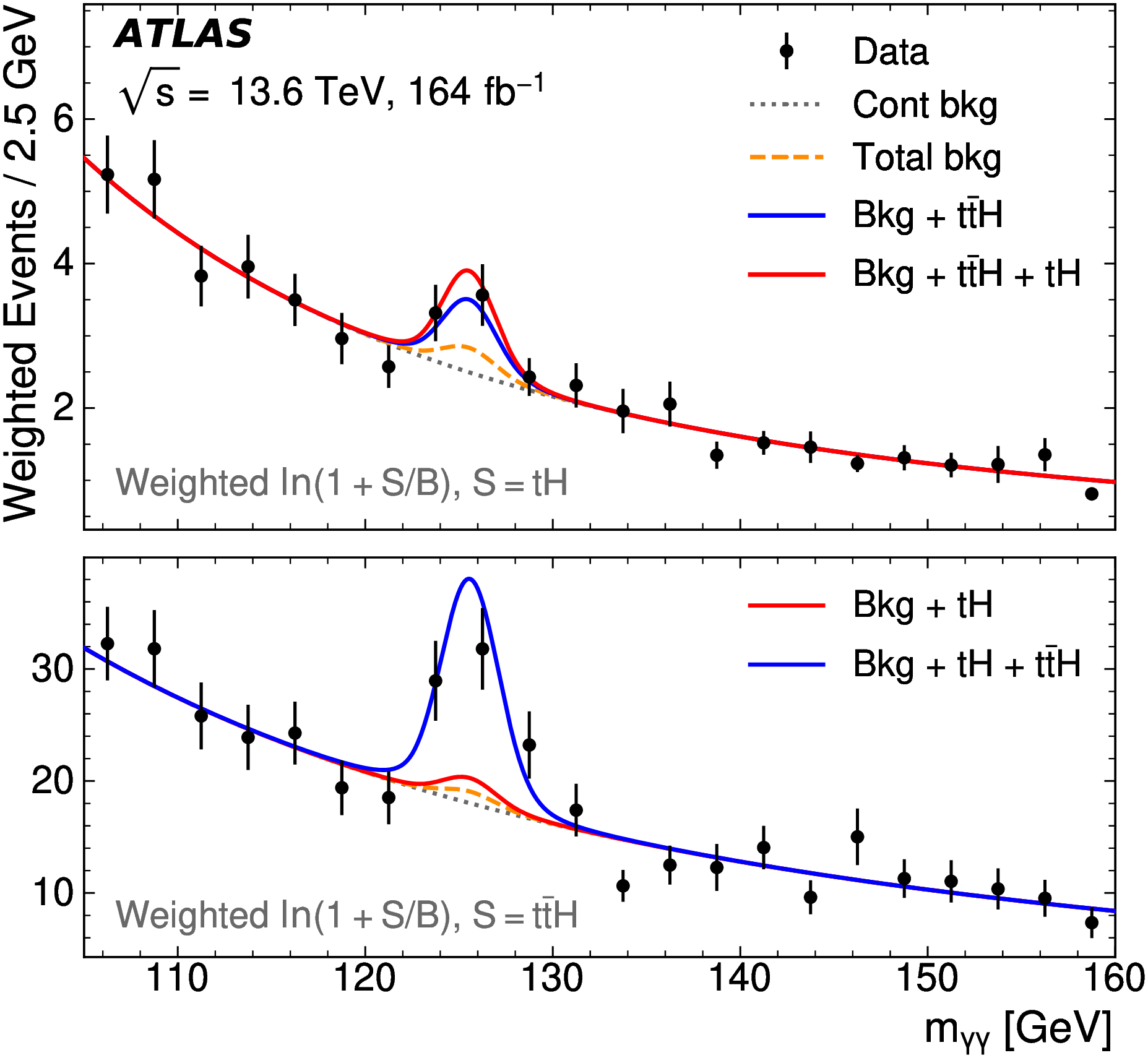
In a new analysis, the ATLAS Collaboration examined 164 fb⁻¹ of 13.6 TeV proton-proton collisions (collected between 2022 and 2024) to study Higgs-boson production in association with either a top-quark pair (ttH) or a single top quark (tH). Researchers focused on events where the Higgs boson decays into two photons, due to its clean experimental signature and excellent mass resolution. As shown in Figure 1, the Higgs-boson signal appears as a narrow peak in the diphoton mass distribution, distinct from background events.
A major challenge of this analysis arises from the similarity and complexity of the signatures involved in the studied production modes. In particular, the tH process is difficult to isolate. The Standard Model predicts it to be especially rare because the mechanisms that produce tH do not simply add up. Just as overlapping waves can cancel each other out, these quantum mechanisms can interfere destructively. In the tH process, this destructive interference arises between diagrams in which the Higgs boson couples to the top quark and those in which it couples to the W boson; their cancellation suppresses the tH production rate. Any CP-violating component of the top-Higgs interaction would change the rates and kinematic patterns of ttH and tH events. These changes provide a handle for studying the CP structure, but they also further complicate the separation of closely related ttH and tH signal patterns from one another and from background events.
Even slight deviations from the Standard Model could change how often Higgs bosons are produced with top quarks or leave subtle traces in collision event shapes
To address these challenges, ATLAS researchers used graph neural networks that examine reconstructed particles and their relationships. This approach allowed the team to avoid explicit top-quark reconstruction, which can be ambiguous and introduce its own uncertainties, and instead directly sort events into regions enriched with ttH or tH signals. Events with topologies that are more CP-odd or CP-even were also identified.
The results show no significant deviation from the Standard-Model prediction. Physicists measured the ttH signal strength to be 1.13 +0.33/-0.28, with a corresponding production cross section times decay branching ratio of 1.46 +0.40/-0.35 fb. This is the first ttH cross-section measurement at 13.6 TeV. Given how rare the tH process is, the amount of data used was not enough to establish its production cross section. Therefore, researchers set an upper limit of 6.2 times the Standard-Model prediction (4.4 expected) at 95% confidence level. This represents the most stringent single-measurement limit on tH production to date.
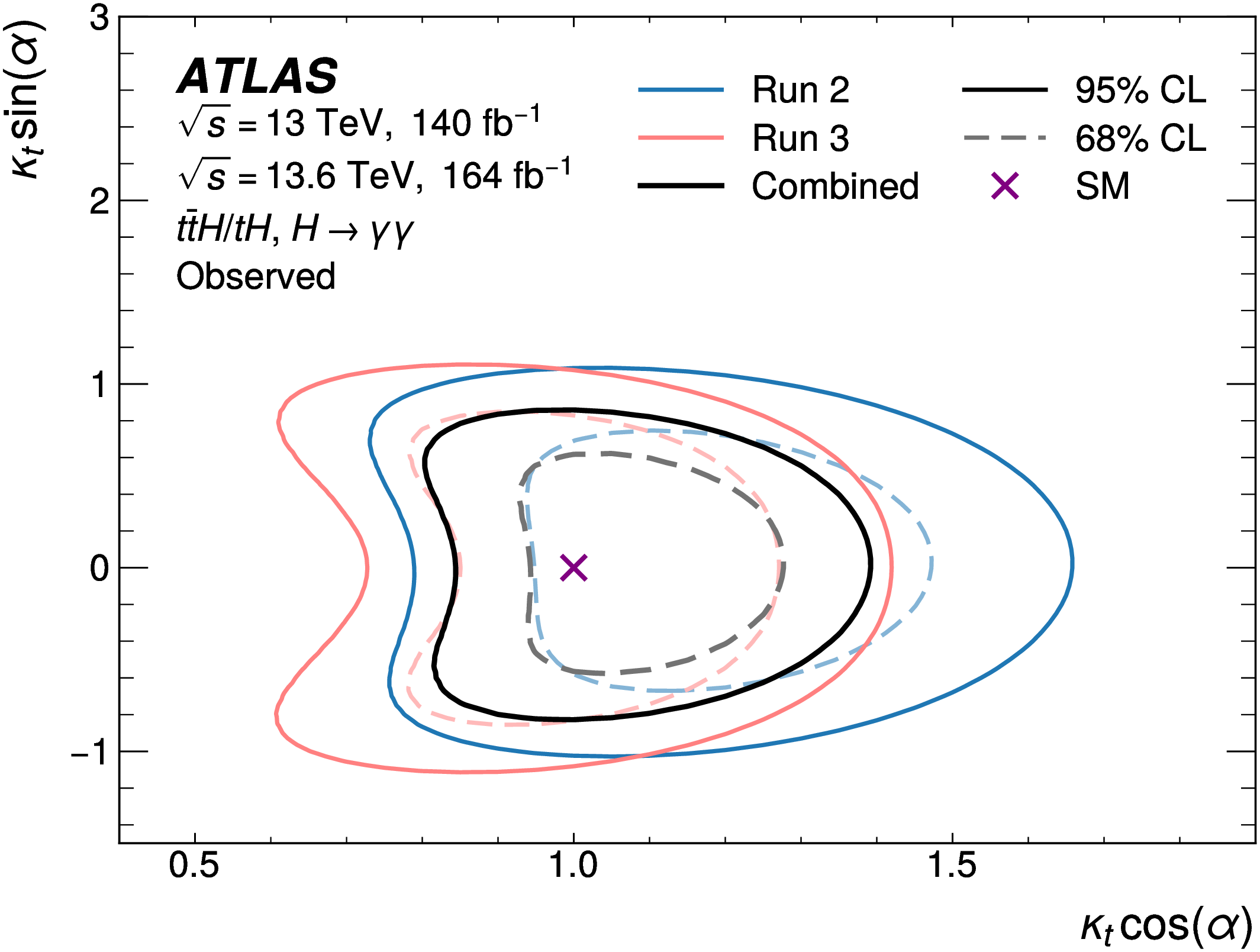
Researchers then tested whether the top–Higgs interaction could contain a mixture of different CP components. The degree of CP mixing is parameterised by the mixing angle α, where 0° corresponds to a purely CP-even interaction and 90° to a purely CP-odd one. Mixing angles larger than 53° were excluded at the 95% confidence level. To strengthen their interpretation, the team combined these results with a previous study of 13 TeV data (collected in 2015-2018) to achieve the most stringent ATLAS constraint to date on the CP structure of the top–Higgs interaction (see Figure 2). They excluded mixing angles larger than 38° and rejected the possibility of a purely CP-odd top–Higgs interaction at 5.8 standard deviations.
These results significantly improve our understanding of the top–Higgs interaction, including its strength, its rare single-top production mode and its CP structure. While no deviation from the Standard Model has yet been observed, this new analysis strategy gives ATLAS researchers stronger tools with which to search for signs of new physics in this interaction.
Learn more
- Probing the Higgs-top Yukawa interaction in the ttH and tH processes using H→γγ with the ATLAS detector (arXiv:2606.04855, see figures)
- Search for the associated production of a Higgs boson and a single top quark in the H→ττ decay mode and combined measurement of tH production using pp collisions at 13 TeV with the ATLAS detector (ATLAS-CONF-2026-002)
- Search for the production of a Higgs boson in association with a single top quark in pp collisions at 13 TeV with the ATLAS detector (JHEP 10 (2025) 093, arXiv:2508.14695, see figures)
- 𝐶𝑃 Properties of Higgs Boson Interactions with Top Quarks in the 𝑡𝑡𝐻 and 𝑡𝐻 Processes Using 𝐻 -> 𝛾𝛾 with the ATLAS Detector (Phys. Rev. Lett. 125 (2020) 061802, arXiv:2004.04545, see figures)
- ATLAS maps the top quark–Higgs boson interaction with multileptons, Physics Briefing, February 2026
- Searching for new sources of matter–antimatter symmetry breaking in Higgs boson interaction with top quarks, Physics Briefing, April 2020